


Used Electric Vehicles for Seniors in 2026: A Practical Guide
The best used electric car for seniors is not the one that steals all of the attention from a nearby saloon, hatchback or SUV and shows off its speed; it's got to be more like an appliance that quietly fades into the background noise of day-to-day life. For some, it will be a Chevrolet Bolt EUV that pampers nicely in the garage and shrugs off errands each week. For some, it could be a Kia Niro EV (which still feels very much like an SUV that's just friends with smaller SUVs) or the Nissan Leaf that seems to make driving around town in little hops pretty easy. Learn the basics: visibility, comfort in your seat and controls, an ideal variety of safety tech. Stack on top of that real-world range requirements, and total cost of ownership.
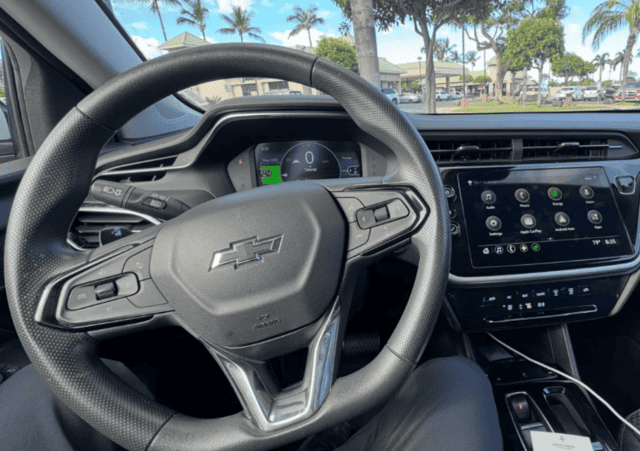
Why Elderly Drivers Are Reconsidering Electric Vehicles in 2026
By 2026, many senior drivers are re-examining electrical motor vehicles (EVs). Seniors have long been a reluctant demographic for EV adoption, but after changes in recent years to this story. Concerns around rising gasoline prices and lower running costs for EVs are the two main reasons why, with surveys suggesting a clear majority of drivers aged over 55 would switch to electric primarily as money savers.
Moreover, range anxiety has been alleviated by the improvement of charging infrastructure as well as battery lifespans. For retirees relying on fixed incomes, Oil changes nothing? Also less need for maintenance!Lower fuel costs make the EV a logical financial option.
Why Electric Cars Are a Great Choice for Elderly Drivers
Electric cars come equipped with certain unique benefits which suit senior drivers naturally. One, electric vehicles are quiet and smooth and vibration-free, thereby guarding against driving fatigue while conversing or listening to navigation instructions. There is no gear changing or clutch fiddling with a single-speed transmission, so this makes driving extremely simple.
Regenerative braking systems permit so-called "one-pedal driving," meaning there's less need to constantly move back and forth between brake pedal and accelerator—an alleviation, especially for those with stiff knees or arthritis. EVs also tend to have a lower center of gravity, and crossover models often provide higher seating positions for easier access.
Most modern EVs also include an ADAS (advance driver-assistance systems) package that includes features such as blind-spot monitoring, automatic emergency braking and lane keeping assist—which might be the safety net some drivers sorely need if their reaction times have been affected.
A Quick Shortlist of Suitable Electric Cars for Seniors
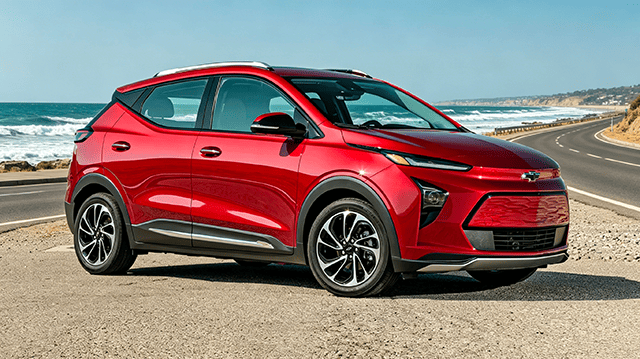
Chevrolet Bolt EV & EUV
The Chevy Bolt EV and its slightly bigger sibling the EUV remain available in 2026, and also represent best buys for seniors on the used market. Both models have great handling, spacious interiors for their size as well as a high roof line (especially with the EUV) which gives you plenty of headroom and visibility. The Bolt family is also known for an infotainment system that uses gauges that are easy to read, along with simple physical controls instead of overly complex touchscreens commonly found in some new luxury EVs.
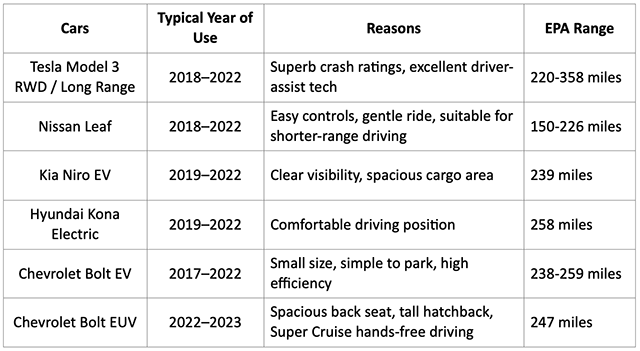
When new, the Bolt has a real-world range of roughly 238 to 259 miles depending on configuration and pricing in the used market proved aggressive due to previous revisions that reduced prices across multiple trims, making it an excellent value for seniors who mainly use their car for local driving errands or social visits.
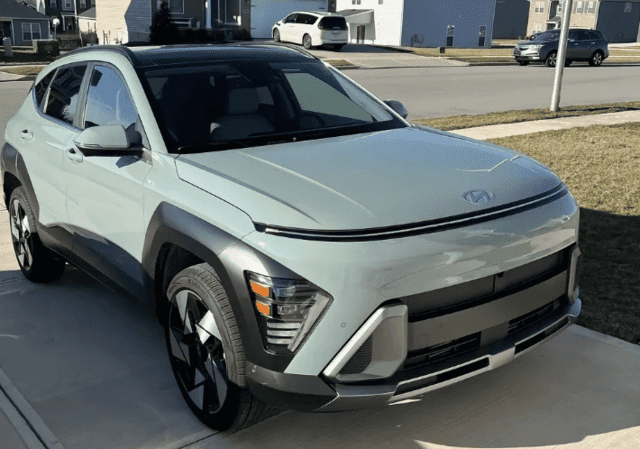
Hyundai Kona Electric
The Hyundai Kona Electric is a compact crossover that finds just the right compromise for older drivers desiring an SUV's higher seat but not its greater size. Easy to access and offers a commanding view of the road ahead. The Kona Electric keeps physical knobs for climate control and volume, which lots of older buyers like compared to touchscreens-based controls.
The car has good safety scores and rides comfortably, soaking up bumps well. The Kona Electric's driving dynamic will be familiar to seniors moving down from a larger gas SUV, but the running costs are far cheaper and it has enough range for most typical muck at regional trips.
Kia Niro EV
The Kia Niro EV is one of the most popular picks for seniors who like to stay busy running errands, engaging in grandkid duties and taking on weekend adventures without feeling overly-large. As a result, the Model 3 has an easy-to-open hatchback style with a low load floor to make loading groceries, medical equipment or luggage simple.
Visibility from the cabin is also excellent with large windows and a beltline that's low enough to help you see almost all around you when parking or judging traffic. Along with a nice ride and user-friendly controls, the Niro EV also has plenty of safety equipment. It acts out of the box, considering its small exterior dimensions in tight areas and parking as well so that passengers could sit with ease inside.
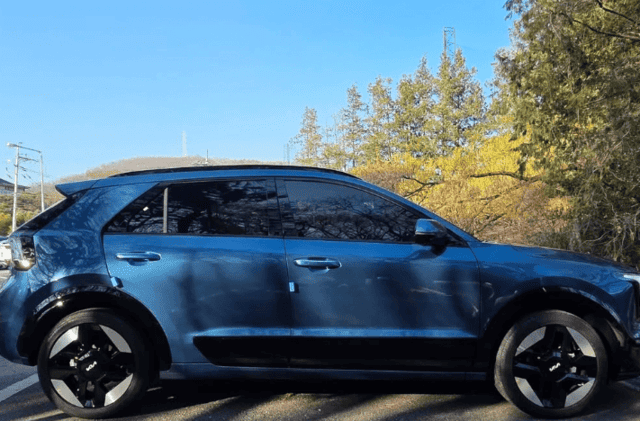
Nissan Leaf
The Nissan Leaf has been a mainstay for older drivers that want to go electric, and it's still one of the best options in 2026—especially if you're shopping used. It is noted for its ease of use with familiar controls, soft ride and good visibility. The Leaf's upright seating and traditional dashboard layout make it the perfect "first EV" for seniors trading in their gas-powered vehicles.
Older models had relatively short ranges but you will now find newer used examples (2018+) fitted with either the 40 kWh or 62 kWh battery packs that, based on usage and other factors, can provide sufficient range (up to around 212 miles) for driving in town do appointments at places of interest.
Buyers should also be careful with older models, especially in hotter climates where the leaf batteries seem reluctant to retain their initial capacity over time but for those buyers who can home charge and mainly do low mileage local runs then the Leaf represents great value coupled with excellent usability on a day-to-day basis.
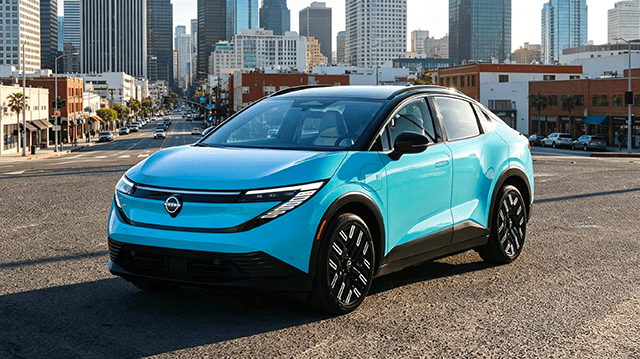
Tesla Model 3
For the tech-savvy senior citizen, it's probably best suited as an advanced offering: The Tesla Model 3. It boasts impressive crash safety ratings, a very efficient powertrain and it will even allow your family to travel knowing that the extensive Tesla Supercharger network is there for stress-free road trips. Many of the available Autopilot and advanced driver-assist features also cut down on highway fatigue over long drives.
However, there are some disadvantages of the Model 3 for these older drivers: it has a significantly lower seating position and precision from knee or hip problems can be difficult to get into if things go wrong, he points out, while virtually all controls on the vehicle are housed withing controls in a central screen.
The interface is manageable for seniors who are already familiar with smartphones and tablets, but it also might not be ideal for older people who prefer physical buttons and dials because the learning curve could be steep. Best for active seniors who want modern safety technology and access to the network more than a classic dashboard layout.

How to Help Older Drivers Test Drive Used Electric Vehicles
So when helping an elderly driver doing a shakedown of EV, comfortableness over acceleration and kind features is predominant. Assessment begins in the parking lot: can they slide right into or out of their vehicle, or do you see them grasping for the door frame? Make sure they can set themselves and the mirrors without fighting their way through an elaborate touchscreen menu.
Focus on visibility while driving, look for big blind spots and also the readability of fonts used in steering wheel or dashboard. Try the parking assists, backup camera and blind-spot monitoring because these also can be vital help for senior drivers.
Finally, simulate a "charging stop" by articulating the need for it to open and then speaking about how easy at home charging really is in grandeur fashion that reinforces you can fill me up overnight like your smart phone. The aim is to make the driver feel in control and safe, that car makes their life easier not more difficult.
Summary
There is no one perfect answer but most older drivers really appreciate the comfort, visibility, range and value of the Chevrolet Bolt EUV, Kia Niro EV or Hyundai Kona Electric best. They ride a bit higher than other sedans, easy to park and offer useful driver assists such as blind spot monitoring and automatic emergency braking on the correct trims.

Protecting Your Digital Assets in the Modern Age
As the world continues to go online, the importance of ensuring your digital assets are protected reaches the same level as securing physical assets. Digital assets can be quite eclectic, including; cryptocurrency, online accounts, intellectual property, sensitive documents and social profiles. The growing threat to cyber security, whether its hacking or phishing, now necessitates that strong security protocols be in place to restrict access and potential loss.1.Strong and Unique PasswordsA password isn’t always enough to protect your digital property, one of the most basic things you can do to protect your digital self is have a password that’s strong and unique for every account. Too many of us don’t listen to that message — and wind up using the same password across multiple sites, which can have a domino effect of abuse if security at a just single one of those sites is compromised. A complex password would consist of mixed upper and lower case, numbers, and special characters.2.Two-factor AuthenticationTwo-factor authentication (2FA) is an extra security layer beyond just a password. 2FA serves as a second form of identification and, as such, serves as an extra bar to entry for any unauthorized person looking to access your account or device, and thus, the sensitive information contained within. By requiring a second form of proof, something like a fingerprint or a one-time mobile code or a physical security key, for instance, 2FA raises the bar on entry. Many major services, ranging from banks, email providers, and cryptocurrency exchanges all support 2FA. A simple yet useful step to increase security is to have it turned on wherever possible.3.Secured Private KeysIf you are a cryptocurrency or a blockchain-base-asset holder, you should make sure that private keys are secured. There is no way to recover lost or stolen keys (unlike bank accounts). So backup is critical. In any case, don’t put your private key on the internet, or anywhere nice and easily available online such as an email or cloud storage. All devices and software should be updated to have the necessary security patches. Also our approved antiviruses and malware scanners can find threats in real time before they do any damage.4.BackupsBackups are really the unsung heroes in protecting your digital assets. Ransomware attacks, hardware crashes or an accidental deletion can erase years of data in a heartbeat. By periodically saving important file into an external hard drive or a reliable cloud service you make recovering something overhead easier. For the greatest safety, the “3-2-1” rule is often recommended: Have three copies of data, on two different storage types, with one stored offsite.5.Never Click on Suspicious LinksSocial engineering assaults, like phishing on email or a phony call to customer support, they exploit human weakness rather than technical ones. And always double-check the legitimacy of requests for sensitive information, never click on suspicious links. Knowing common scams and educating yourself and others about them can save time and money.6.Long-term PlanningLastly, examine estate planning for long-term planning of digital assets. A great deal of digital accounts and holdings are not available to heirs without certain documents. If you have a list of accounts, passwords and instructions to it and share it with a lawyer or family member you trust to access it after your death, this will ensure your valuable assets are distributed the way you want. For digital security, it’s also imperative to maintain up to date software, updating it as it becomes available. And a lot of cybercriminals take advantage of weaknesses in outdated operating systems, applications or firmware.Ultimately, in a world that is increasingly connected, proactive security is critically not a luxury but a requirement. You can take action to mitigate the risk to themselves and their digital assets with this sequence of steps to protect themselves in the longer term.

Turmeric May Cure Your Indigestion
Indigestion, a common gastrointestinal disease, affects millions of people all around the world whose features are abdomdistension, heartburn, nausea and abdominal pain. Although there are lots of nonprescription drugs to deal with these problems, many patients still turn to natural therapy in order to find a safer and more efficient surrenal. So here comes turmeric, one of the most attention-paid therapy among us recent years. It is a normal bright yellow spices widely used in India. More and more studies show that turmeric, especially its active compound curcumin, can curtail and lower the symptoms of indigestion of patients.The Science Behind Turmeric and IndigestionTurmeric was extracted from the roots of zedoary plants and has been used to cure all kinds of diseases in traditional therapy for centuries, particularly in ayurveda and traditional Chiniese medicine. The active compound which is named curcumin is famous for its powerful function and efficiency in anti-inflammatory, antioxidant and antibacterial agents. These characteristics make turmeric become an ideal and optimal drug for treating diseases about indigestion.One of the core mechanics that turmeric has something good in curtailing indigestion is its anti-inflammatory function. Chronic inflammations of the gastrointestinal tract are the common potential factors which include a series of digestion diseases, not only indigestion. Curcumin has an effect in inhibiting the production of pro-inflammatory molecules (like cytokines and prostaglandins), which are involved in the inflammatory response. By decreasing inflammation, turmeric can help relieve the uncomfortable feelings brought by indigestion.Practical Tips for Using Turmeric for Indigestion1. Choose high-quality supplements: When choosing turmeric or curcumin supplements, you ought to look for the products containing a standardized extract with a high curcumin content. Combine the turmeric with one compound which is named piperine in black pepper, you can enhance the bioavailability of turmeric, then the purpose of escalating the turmeric intake inside your body is achieved.2. Add turmeric into your diet: A most easy but direct way which can maximum exert the beneficial features in turmeric is to add it into your diet or add it into curry soup or smoothies. Besides, you can also grind turmeric into powders and take in them with meals usually. In this way, you can possess a healthy body.3. Consult a doctor: Before you start to eat turmeric supplements to cure indigestion or other purposes, please do remember to talk to your doctor and listen to his or her suggestions, especially if you have some health problems or are in the period of taking prescribed drugs. What’s more, they can provide you with individualized information to help you find the best solution to deal with relevant health issues.4. Consistency: According to scientific testimonies, turmeric and its major compounds are helpful for indigestion relief.

A Guide to Choosing the Perfect Used Car for Seniors
Understanding Specific NeedsThe first stage is an extensive evaluation to determine the driver's individual requirements and body considerations. Crucial questions for the customer to answer: What will you use the car for—primarily errands around town, or longer trips? Are easy in/out important to them for mobility reasons? Think in terms of larger door openings, seats at a convenient height (but not too low) and easier-to-use controls. Visibility is also key; seek out cars with good all-around sight lines and large, clear mirrors. A midsize sedan, a small SUV or crossover, or a minivan will usually provide the right mix of accessibility, visibility and ease-of-management for many seniors.Setting a Realistic BudgetWhen budget setting, look past the sticker price. Take into account the cost of ownership, including insurance rates, fuel economy and any repair or maintenance expenses. In general, cars with reputations for reliability might have a higher up-front price but produce lower long-term costs. Budget for a pre-purchase inspection by a trusted mechanic and for any minor, immediate adjustments or repairs (new tires, updated prescription lens side mirrors).Focusing on Simplicity and ComfortComfort is everything when it comes to an "adrenaline-inducing ride. Listen closely in the initial sit-test: Do the seats feel supportive and easily adjusted? If you sit in the driver's seat, are all the important controls easy to use, reach and operate? Prefer physical knobs and buttons as opposed to intricate touch-screen menus for climate and audio control. Contemporary safety technology such as a backup camera, blind-spot monitoring and automatic emergency braking are meaningful support systems that can foster confidence and security.Choice of Shopping: Private Sales, Dealers and Certified Programs1.Private Sales: Every so often, you can get an absolute steal of a deal through a private sale but it comes with additional risk. In order to prevent unforeseen problems, an outside mechanic should inspect any car sold by a private party prior to purchase. Negotiation is more common in private sales, but caution is recommended.2.Dealers: New car dealerships typically offer a good selection of used cars. Dealers, particularly when it comes to their fleet of pre-owned vehicles tend to set the bar pretty high. In many cases these cars have been through rigorous inspections and are a great option.3.Certified Programs: CPO vehicles have been checked and refurbished by the manufacturer for mechanical issues, or covered under manufacturer-provided warranties and high-quality financing. They tend to be less risky than standard used cars and can make a lot of sense when reliability is high on your priority list.The Essential Test DriveThe test drive is everything. Slip it in there at a time when you can hit the road in different conditions, both on city streets and highways. Inspect how well the car rides — is it smooth and steady? Check the acceleration and braking to make sure it feels responsive, but not jerky. Look for convenience to parking and the ease of getting in and out. The most critical is to make sure the driver is confident and comfortable driving., every switch should fall to hand and feel right in an instinctual way.Approach them with the aid of carefully observing these steps: evaluating what you need; budgeting sensibly; insisting on comfort; checking the history and taking an extended test drive, because then you'll know what's really going on with a used car when it's your turn as a purchaser. The proper used car will provide the peace of mind, comfort and reliability to facilitate years of independence and freedom.

How to Choose Sunglasses for Travel
Sunglasses are not only a fashion accessory, but also an essential item for protecting your eyes from harmful UV rays when travelingChoosing the right sunglasses for your travels involves considering various factors to ensure they provide adequate protection and suit your style. Here are some tips for choosing sunglasses for travel:UV Protection: Look for sunglasses that provide 100% UV protection. This is crucial for shielding your eyes from the sun's harmful radiation. When purchasing sunglasses, check for labels or stickers indicating UV 400 or 100% UV protection.Lens Quality: Consider the quality of the lenses. Opt for sunglasses with polarized lenses to reduce glare and improve visibility, especially during outdoor activities. Also, ensure the lenses are impact-resistant and provide a clear, distortion-free view.Frame Fit: Choose sunglasses that fit your face shape and size. The frames should snugly sit on your nose and ears without causing discomfort or slipping. Different face shapes suit different frame styles, so consider what best complements your features.Lens Color: The color of the lenses affects your contrast and color perception. Gray lenses provide minimal color distortion, while brown/amber lenses enhance contrast. Consider the activities you'll engage in while wearing the sunglasses to determine the most suitable lens color.

Effective Ways to Relieve Joint Pain
Joint pain, which affects millions of people worldwide, is commonly linked with arthritis, injury, overuse and other causes. While persistent or severe pain should always be evaluated by a health care provider, there are many helpful steps you can take to prevent effectively and relieve pain around you joints.1.Regular Exercise and Physical ActivityRegular physical activity is one of the best weapons against joint pain. Though that may seem counterintuitive — who wants to move painful joints? — movement is what builds strength in the muscles surrounding the joints, giving stability and reducing the strain. Low-impact exercise to producing flexibility and stimulating circulation, like swimming, cycling and walking, is particularly effective, in that it doesn’t put strain on the joints. Yoga and stretching routines might also help improve range of motion and reduce stiffness. For people who have chronic joint pain, seeing a physical therapist is strongly recommended so that an individualized exercise plan can be developed. That regular, moderate abstraction of activity will make a difference in keeping joint serious pain from dog titling over time.2.Maintain a Healthy WeightCarrying excess weight also puts significant stress on the weight-bearing joints in the body, including the knees, hips and ankles. At even modest levels, weight loss can substantially relieve joint pain and slow the progression of diseases like osteoarthritis. A healthful, antiinflammatory-rich diet bolstered by leafy greens, berries, nuts and fatty fish can assist with weight management and help suppress inflammation. Limiting processed foods, sugars, and alcohol is just as crucial. You can be free from joint pain and improve overall health and reduce the risk of other chronic conditions by maintaining a healthy weight.3.Heat and Cold TherapyThis therapy with heat and cold joints, as well as helpful, simple, affordable and efficient. Using a warm compress, heating pad, or warm bath can help relax muscles, increase blood flow and ease stiffness, which research has shown is best for chronic pain or morning stiffness. Cold therapy, like an ice pack or cold gel wrap, is numb the area, reduce swelling and can relieve acute pain or inflammation from overuse or injury. For others, alternating between heat and cold works particularly well. When applying heat or cold directly, always apply a barrier, such as a towel, to protect your skin.4.Mind-Body TechniquesChronic joint pain can be a serious drain on one’s mental health, and stress, in turn, can make physical pain worse. Mind-body techniques such as meditation, deep breathing exercises, and tai chi can benefit stress reduction, emotional well-being, and even pain control. These practices promote relaxation, mindfulness and a greater sense of mind-body control — all things that can empower those suffering from chronic pain. Tai chi also integrates gentle motion with mindfulness, which can help increase joint flexibility and minimize pain.5.Good Posture and Use of JointsBad posture and repetitive use may intensify joint pains with the time. Even awareness of your posture — sitting, standing or walking — can help share your weight more evenly, relieving stress on your joints. Ergonomic tweaks, like supportive chairs or cushioned mats, can also help a lot. Assistive devices (e.g, braces, splints, or canes) can also help people with arthritis or other ongoing chronic conditions by providing extra support and alleviating pressure on affected joints.In conclusion, joint pain can be a very difficult condition to cope with, as much mentally as it is physically— so you should not let the symptoms run your life. Manage and relieve your pain with you regular exercise, maintain a healthy weight, use heat and cold therapy, try mind-body techniques and protect your joints. Again, please keep in mind you must check in with a healthcare professional to tweak these approaches to fit your particular situation. But with the proper technique, you can effect preventative measures toward a more active, pain-free you.